Bernini’s Quest for Happiness:the story of St. Peter’s Square
By Peter de Kuster
In Search of Happiness
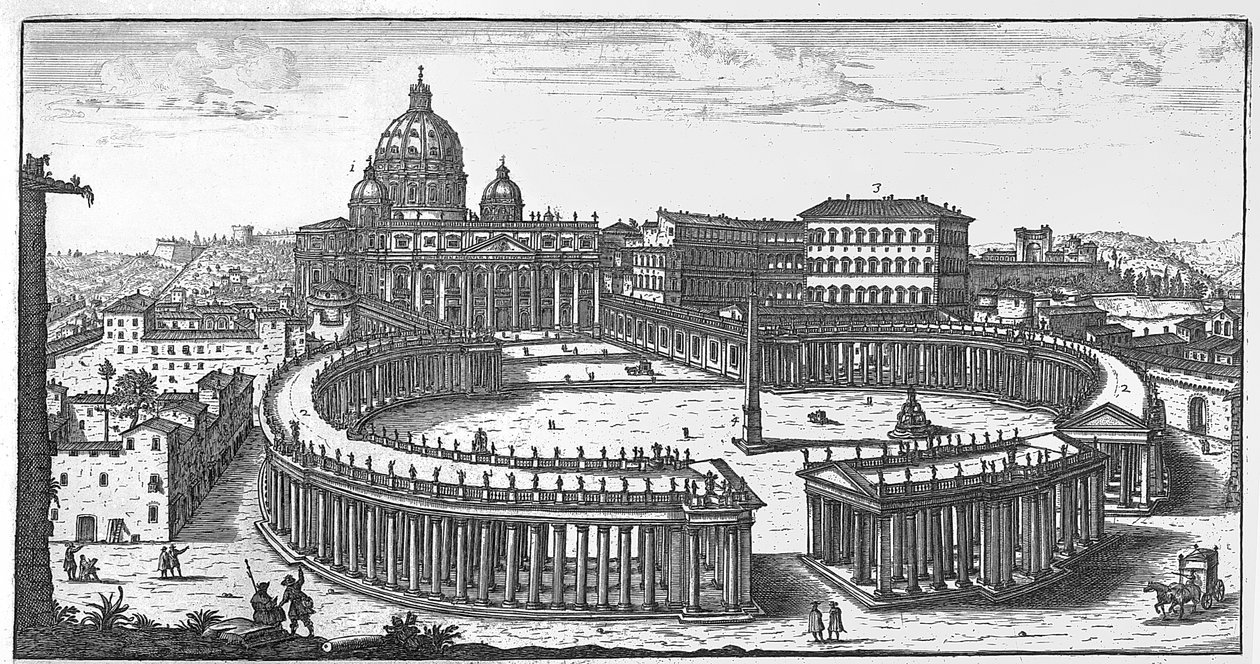
In the golden haze of a Roman afternoon, where cypresses pierce the sky like a sculptor’s chisels and the Tiber hums with centuries of ambition, Gian Lorenzo Bernini (1598-1680) pursued true happiness not through idle leisure or fleeting fame, but through the deep, effortless immersion of total creative absorption. In this private tour I trace Bernini’s transformative journey to St. Peter’s Square (Piazza San Pietro, 1656-1667)—his transcendent colonnades curving outward like motherly arms to embrace pilgrims in divine welcome. Here, amid papal intrigue and marble’s vast challenges, Bernini discovered happiness in that zone where challenge perfectly matches skill, time melts away, and the self dissolves into pure, self-rewarding creation. This private tour in Rome unveils how Bernini harnessed these principles during eleven grueling yet ecstatic years, turning monumental obstacles into peaks of fulfillment. Let this reflection guide your own search for happiness, showing how balanced challenge, clear purpose, and total engagement unlock life’s deepest joy.
The Call to Grandeur: Challenge Perfectly Matched to Mastery
Bernini, at 58, received Pope Alexander VII’s summons in 1656: tame St. Peter’s chaotic forecourt into a piazza for 100,000 souls. Michelangelo’s massive dome loomed unfinished; Rome’s hills and papal wars posed brutal logistics. Yet this was no overwhelming terror—nor dull repetition. The scale perfectly tested Bernini’s lifetime of skill: boy prodigy who carved living putti at eight, who twisted bronze columns for the Baldacchino (1624-1633), who captured Apollo and Daphne’s metamorphosis mid-flight (1622-1625). Happiness began here, in perfect balance—his hard-won mastery rising to meet unprecedented scope. Dawn sketches birthed ellipses over rectangles: 340m by 240m oval, 284 quadruple Tuscan columns sweeping 450m perimeter. Each morning in Tivoli quarries, fingers tracing 20,000 tons of travertine veins, Bernini felt the rightness: challenge sharpening skill to its brightest edge, anxiety banished, boredom impossible—pure engagement ignited.
Purpose Crystallized: The Maternal Embrace Takes Form
A sharply defined goal anchored every chisel stroke: create the Church’s “maternal arms” enfolding the faithful. No vague grandeur—this precise vision shaped every curve, every column’s entasis swell mimicking welcoming flesh. Blueprints pinned to scaffolds like sacred writ; 140 saints carved as heaven’s honor guard; ancient Egyptian obelisk repositioned as cosmic axis; twin fountains jetting psalmic waters. Mornings brought clay maquettes scaled 1:10, Bernini’s fingers kneading till the form “sang homecoming.” Alexander VII climbed scaffolds, tears tracing cheeks: “It gathers my flock like a mother.” This clarity eliminated hesitation—every decision flowed from the singular purpose of sacred welcome. Happiness deepened through focus: no scattered effort, but laser-sharp intent driving stone alive with meaning.
Stone’s Instant Reply: Feedback Loops of Living Creation
Marble spoke back immediately, chisel by chisel. Perfect strike rang harmonic truth; flawed angle echoed discord. Half-columns rising by 1660 drew gasps from early pilgrims: “It pulls us home!”—external confirmation flooding in. Bernini tested illusions relentlessly: draped cloth over models mimicking fog, ensuring curves invited rather than repelled; noon sunlight checked obelisk shadows for exact alignment. At 65, scaling precarious rigs: “Wider arc—embrace all nations!” Masons’ grunts, pulley creaks, crowd murmurs wove instant dialogue between vision and reality. No agonizing delays—just continuous correction, action meeting response in seamless rhythm. Happiness surged through this dialogue: stone’s whispers confirming each step, building certainty stroke by stroke, the work itself becoming its own reward.
Total Absorption: The Sacred Hut and Scaffold Trance
Amid Rome’s 1660s chaos—clattering carriages, hawking vendors, papal funerals—Bernini created sacred isolation. His site hut stayed monkishly spare: bread, wine, candlelit sketches. Nights glowed with torches as shadows prototyped solstice light plays across the ellipse. Thousands of workers hammered nearby, yet Bernini entered deep concentration: world shrinking to curve, gleam, proportion. Eleven years unbroken (1656-1667)—focus piercing plague scares, funding crises, Alexander VII’s death. Dawn quarry oversight flowed into midday scaffold dances, barefoot along ropes tracing arcs: “Higher—she must hug wider!” No distractions penetrated; external noise dissolved into stone’s silent call. Happiness lived here, in total immersion where scattered attention vanished, leaving only the work’s pure pulse.
Effortless Control: Suggesting Rather Than Forcing Stone
Bernini worked from deep confidence: “I suggest; marble decides.” Columns’ subtle entasis pulsed like breathing flesh; 8-story travertine drums hauled by ox trains arrived flawless. When 1661 gales toppled scaffolds, knee bleeding at 63, he laughed: “God tests the embrace’s resilience.” Rebuilds birthed stronger innovations—wind-braced arches, deeper foundations. Fountains jetted 24m arcs through hidden bronze jets, mocking gravity. This wasn’t rigid domination, but relaxed mastery—knowing exactly what needed doing, then watching material respond. Happiness flowed from this paradox: complete confidence without force, action unfolding naturally from deep skill. Borromini’s rival Sant’Agnese waves undulated nearby; Bernini’s gentler ripples answered with perfect subtlety, control made effortless through total preparation.
Action and Awareness Merged: The Seamless Creator
No gap existed between Bernini and his creation. Sketches flowed mid-stride across dusty sites; clay caked his nails during supper debates; his voice boomed rhythms that synchronized a thousand hammers. Dawn brought chisel guideline marks; dusk oversaw pulley lifts—each transition seamless. The 1667 climax crystallized it: procession threading the finished oval, Bernini at center with arms flung wide mirroring colonnades, piazza seeming to breathe with his exhalation. Work wasn’t something he did—it was him. Hammers struck as extensions of thought; stone shapes manifested inner vision directly. Happiness became this fusion: no separation between creator and created, intention and execution flowing as one unbroken breath.
Self Dissolved: From Court Lion to Pure Vessel
Bernini, once Rome’s court darling and “Michelangelo of his century,” shed personal identity entirely. No “I”—only “the piazza.” Critics carped “too theatrical!”—he smiled: “Theater reveals eternal truth.” At 70, knees grinding on scaffolds, he hauled travertine samples home for supper-table touch tests, boyish glee undimmed by age. Pilgrims’ silent awe became sole validation; papal applause secondary. Vanity dissolved in travertine dust—no consciousness of self as separate actor, only the work unfolding through him. Happiness reached its purest depth here: no ego to feed or defend, no audience truly needed—creation complete in itself, profoundly fulfilling without external measure.
Time Dissolved: Eleven Years in Eternal Now
The years 1656-1667 blurred into single moment. Workers grayed and retired; Bernini remained ageless in creative time. Inauguration under Clement IX saw 80,000 flood the ellipse—”yesterday’s dawn sketch suddenly stone.” Hours stretched during feverish problem-solving; weeks vanished in trance-carving; eleven years passed as one sustained breath. Deadlines lost meaning; only the work’s internal rhythm mattered. Happiness transcended clock time: mortality’s weight lifted, replaced by timeless engagement where past triumphs and future fears dissolved into present perfection.
The Rival’s Shadow: Borromini as Perfect Foil
Francesco Borromini (1599-1667) sharpened Bernini’s edge. Early 1630s, Borromini carved marble for Bernini’s Baldacchino; their 1637 plagiarism feud birthed independence. San Carlo’s undulating walls (1634-1641) and Sant’Agnese’s waves (1652-1667) pulsed nearby, challenging Bernini’s curves to greater subtlety. Borromini’s 1667 suicide mid-piazza construction pierced Bernini: “Heaven needed his tormented genius more.” Yet this worthy rival maintained perfect challenge-skill balance—never overwhelming, always stimulating deeper invention. Bernini’s columns rippled gentler than Borromini’s storms, answering theatricality with intimate welcome. Happiness intensified through this dialectic: peerless skill meeting equal challenge, complacency impossible, mediocrity unthinkable.
Quarry to Inauguration: The Creative Rhythm Sustained
Daily rituals sustained immersion. Dawn: quarry oversight, testing travertine resonance by ear. Midday: scaffold dances adjusting arcs till shadows “caressed perfectly.” Afternoon: clay refinements with masons. Dusk: saint statue auditions atop mock columns—”Does heaven approve?” Nights: candlelit sketches projecting solstice light. Eleven years of this rhythm built unbreakable focus—plague closures, papal transitions, funding droughts merely intensified concentration. No creative valleys; sustained peak engagement defined the entire arc. Happiness embedded itself in routine made sacred: ordinary workdays transformed into transcendent rituals.
Engineering Triumphs as Pure Expression
Technical challenges dissolved into creative opportunities. Moving 20,000 tons travertine: ox trains redesigned with ship masts as levers. Obelisk realignment: precise surveying triangulated ancient Egyptian granite with papal precision. Fountain jets arcing 24m: hidden bronze channels harnessed aqueduct pressure. Column capitals—140 unique saints—carved by pupils under Bernini’s eye, each face telling salvation’s story. Every solution flowed effortlessly from deep skill meeting clear need—no wrenching force, but natural unfolding. Happiness saturated these moments: problem and solution merging, technical mastery becoming artistic expression.
Climax and Completion: The Piazza Breathes
1667 unveiling under Clement IX: trumpets blaze, procession threads ellipse, 80,000 souls flooding maternal curves. Bernini stands center, arms echoing colonnades, tears tracing as sunset bathes travertine gold. Pilgrims weep silently; stone seems to exhale welcome. Eleven years crystallized: challenge met skill, purpose guided action, immersion sustained throughout. The piazza didn’t merely stand—it breathed, enfolded, invited eternity.
Legacy: Happiness Made Monumental
St. Peter’s endures as happiness embodied in travertine: oval framing infinity, columns gathering light, saints vigilant above maternal embrace. Bernini died 1680, buried Pantheon-honored. Modern pilgrims still feel the welcome—arms that have embraced billions across centuries. Happiness proved eternal here: creative absorption outliving flesh, communal joy rippling endlessly.
Your Happiness Map: Bernini’s Principles Applied
Bernini reveals my In Search of Happiness model clearly:
- Perfect Challenge: Scale skills without overwhelming—your “piazza” project.
- Clear Purpose: Single goal focusing all energy.
- Instant Feedback: Systems giving immediate truth.
- Deep Focus: Sacred rituals blocking distraction.
- Effortless Control: Confidence from preparation.
- Seamless Action: Work as extension of being.
- Self Forgotten: Creation for its own sake.
- Timeless Now: Engagement transcending clocks.
Reflection Prompts:
- What project perfectly balances your skills?
- Where do you lack clear, singular purpose?
- What immediate feedback have you lost?
- What distractions break your immersion?
- Where do you force rather than suggest?
- When do you separate self from action?
- What pulls you from present engagement?
Bernini found happiness not seeking it, but immersing totally in work matching skill to noble challenge. St. Peter’s Square stands as proof: true joy lives in creative absorption, made eternal through purposeful stone.
Ready to find your piazza—your perfect creative immersion?
Private Grand Tour Experiences with Peter de Kuster
The Story Behind My Private Grand Tours: A Journey Designed for Deep Transformation
As Peter de Kuster, my Grand Tours were born from decades guiding leaders through their hero’s journey—where solitude or intimate partnership unlocks the greatest breakthroughs. I designed these experiences explicitly as private sanctuaries for profound personal or professional transformation, never diluted by groups. Why for you alone or you and your (business or life) partner? Because true happiness quests demand unfiltered space: solo for raw self-discovery, or partnered for shared vulnerability that aligns visions and co-creates meaning. Larger groups fracture focus; business partners synchronize strategies; life partners deepen bonds. This intimacy—my focused presence amid life’s chaos—ensures every insight lands deeply, unhurried, transformative. No crowds, no compromises: just you, your partner, and timeless truths through my In Search of Happiness model.
Private Grand Tour – One Day in Rome
Dawn exploration of Rome’s transformative sites, intimate lunches, hidden scaffold spots, sunset reflections. Exclusively private for 1-2 participants (you solo or with partner). €1,800 per Grand Tour (excl. VAT) – top-tier pricing for elite personalization, including private transport, all entrances, VIP access, and unmatched storytelling mastery.
 The Grand Tour